
"Switching careers to Geographic Information Systems (GIS) wasn't something I had planned." — Darion Sim Yao Teng
A few years ago, my life revolved around gym sessions, fitness plans, coaching clients, and signing up new members at the gym where I worked. I loved what I did. Helping people feel stronger, healthier, and more confident was deeply fulfilling.
But slowly, a quiet thought began to take shape. I started wondering if there was a way I could make a difference beyond the individuals I worked with each day, to contribute to work that shaped communities, solved real-world challenges, and created impact on a bigger scale.
Exploring a new path
The turning point came one afternoon when I spent time talking with my dad. My dad had worked as a GIS professional for many years. Growing up, I often saw him sitting in front of a computer, working with maps and data. For a long time, though, GIS felt like his world, not something I imagined for myself.
That day, he shared what his work truly involved.
He explained how GIS wasn’t just about creating maps, but about understanding problems through data - for example helping governments plan safer cities, improving transport and infrastructure, managing environmental risks, and making better decisions that affect thousands of people at once.
What struck me was the scale of impact.
In fitness, I was helping people one by one. Through GIS, my dad was helping entire communities.
For the first time, I understood how technology and data could be powerful tools for change and how learning GIS wasn’t just a career move, but a way to contribute to real solutions in the world.
That’s what sparked my interest. I didn’t just want to do meaningful work, I wanted to build skills that could make a broader difference.
Instead of telling me what to do, my dad gently suggested I try a short GIS course, just to explore it for myself. That small step planted a seed and became the beginning of a career path I had never considered before.
Learning through trial, error, and persistence
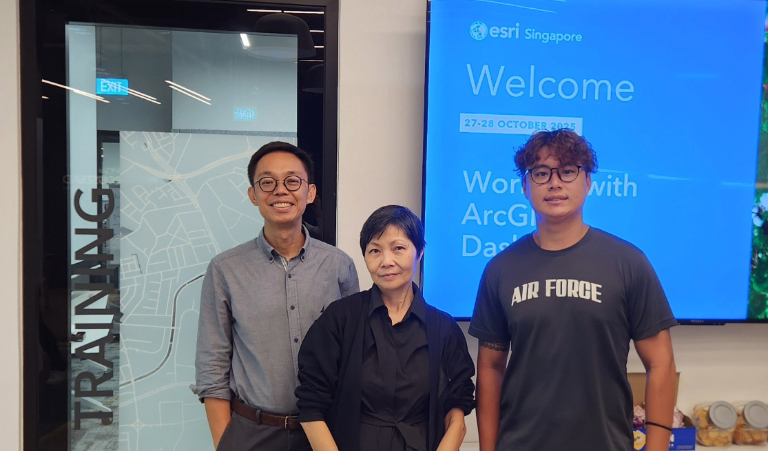
That conversation stayed with me, and it led me to take a small first step, exploring beginner GIS courses with Esri Singapore, following my dad’s suggestion. It felt manageable, a way to try something completely new without committing to a full career change straight away.
The first course I took was a free, self-guided e-learning resource called Getting Started with ArcGIS Pro. In just one day, I was introduced to what GIS really was and how data could be transformed into visual stories through maps. I still remember the feeling of creating my first simple map, and watching information come to life on the screen was exciting in a way I hadn’t expected.
That single experience sparked my curiosity.
Before I knew it, I was signing up for Esri Singapore’s paid courses, including Introduction to GIS Using ArcGIS and ArcGIS Pro: Essential Workflows. Each one built on the last, teaching me how to work with data, analyse it, and share insights using ArcGIS Pro.
It wasn’t always easy. There were plenty of moments where I clicked the wrong button, got stuck, or spent far too long trying to fix what turned out to be a simple mistake. At times, it was frustrating — especially coming from a field where I felt confident and experienced.
But every small breakthrough felt incredibly rewarding.
Slowly, those small wins began to add up. I completed 13 courses, and with each one, my confidence grew. I wasn’t just following instructions anymore — I was starting to understand how the tech worked and how it could be applied to real-world situations.
Taking the leap
Eventually, I reached a point where I felt ready to take a bigger step. Applying for a GIS Specialist role was daunting because it meant fully committing to a career change. Getting the job offer was a moment I won’t forget. It made all the uncertainty, effort, and late nights worth it.
Switching from personal training to GIS wasn’t easy. It meant starting over, being okay with not knowing, and staying committed through the learning curve. But it taught me that growth often comes from being willing to try something new, even when it feels uncomfortable.
If you’re considering a career change, my advice is simple: start small. One course, one decision, or one moment of curiosity can open doors you didn’t know were there.
I’m still learning every day, and I’m excited to see where GIS takes me next.
And if you’re ready to explore GIS for yourself, Esri Singapore offers the same beginner‑friendly courses that helped me get started, from free introductory e‑learning to hands‑on, instructor‑led training.
Your first step could be smaller than you think.